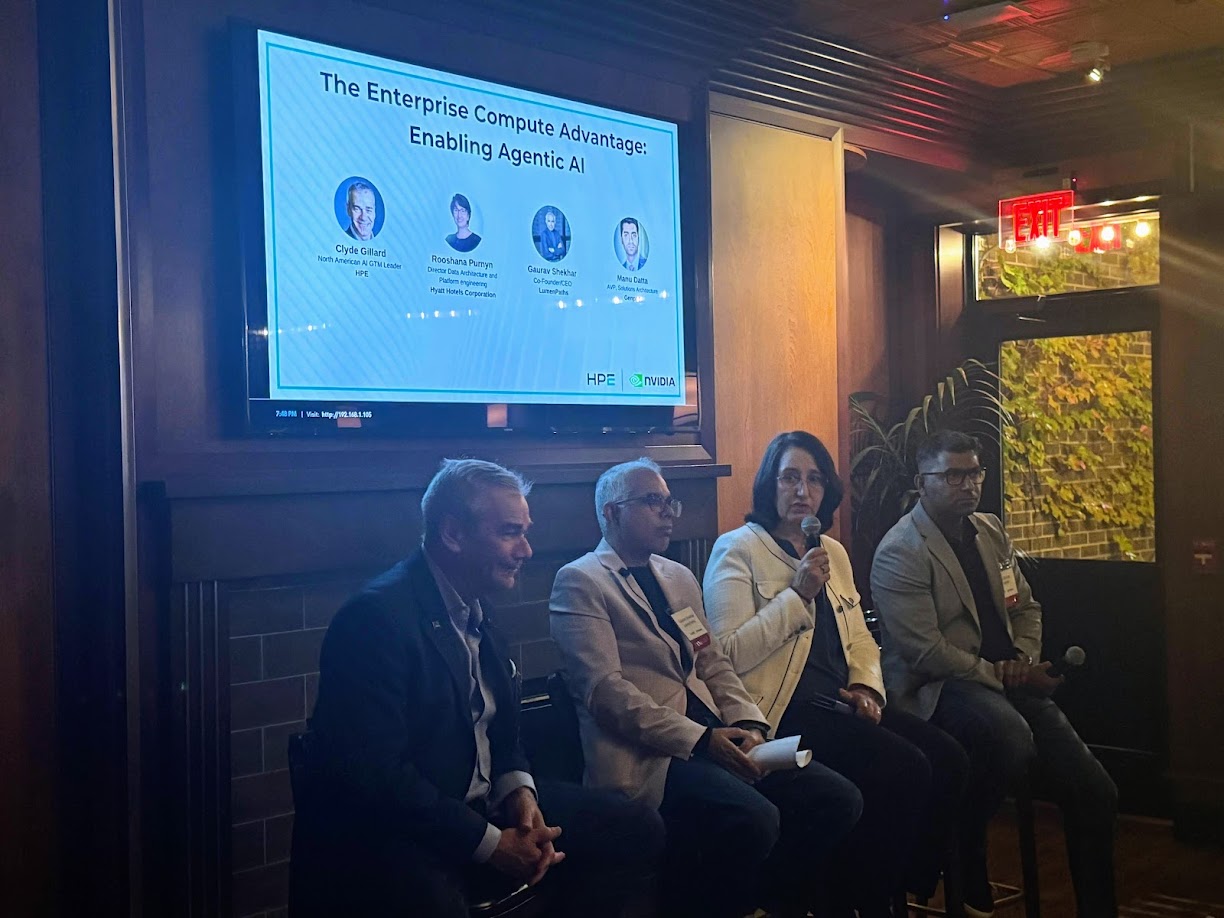
Moderator & Panel
Clyde Gillard
Hewlett Packard Enterprise
Gaurav Shekhar
LumenPaths
Rooshana Purnyn
Former Hyatt Hotels Corporation
Jagat Singh
Intercontinental Exchange
Executive Summary
The discussion explored how enterprises are adopting agentic AI—autonomous systems capable of learning, reasoning, and acting within business environments. Executives emphasized that the greatest challenge is not the technology itself but building the right foundations: trustworthy data, responsible governance, and scalable infrastructure. Leaders agreed that organizations must balance innovation with control—leveraging AI to automate complex workflows while ensuring transparency, compliance, and human oversight where necessary.
Agentic AI’s value lies in its ability to extend beyond static automation, learning dynamically from context and adapting to new inputs. Participants shared examples spanning financial services, hospitality, and enterprise IT—where autonomous systems enhance fraud detection, customer experience, and operational efficiency. Yet they cautioned that these systems demand disciplined data strategy, human-in-the-loop validation, and careful orchestration across cloud and on-prem environments. The future will favor hybrid architectures that keep data secure while tapping into the computational scale of cloud ecosystems.
Ultimately, enterprise AI success depends on coupling innovation with accountability—embedding AI governance, engineering rigor, and human judgment into every phase of design, deployment, and monitoring. As one theme emerged repeatedly: AI should enhance decision-making, not replace it.
Key Themes
Key Themes
-
From automation to autonomy.
Agentic AI moves beyond rule-based automation to systems that can independently reason, act, and adapt—bridging the gap between static automation and cognitive intelligence. -
Governance and human oversight.
Despite AI’s autonomy, panelists agreed that “human in the loop” remains essential. Governance frameworks and accountability structures must evolve alongside technical capabilities. -
Data quality as the core enabler.
Every successful implementation begins with clean, integrated, and well-governed data. Poor or biased data leads directly to inaccurate or risky AI outcomes. -
Security and responsible AI.
Fraud detection, data privacy, and prevention of hallucinations require strong guardrails. Testing, anomaly detection, and layered verification are mandatory before production deployment. -
Hybrid and cloud-native architectures.
Scalability favors the cloud, but many organizations maintain hybrid or private models for compliance, latency, and sovereignty. AI orchestration must flex across both environments.
Actionable Takeaways for Enterprise Leaders
Actionable Takeaways for Enterprise Leaders
-
Define an AI readiness framework.
Audit your organization’s data quality, infrastructure, and governance maturity before launching agentic AI initiatives. -
Invest in secure, scalable data foundations.
Build unified data platforms that ensure accuracy, lineage, and accessibility—enabling trustworthy AI insights across teams and functions. -
Adopt human-in-the-loop design.
Embed checkpoints for human validation within high-impact workflows to maintain control and accountability. -
Implement responsible AI guardrails.
Incorporate model testing, hallucination detection, and explainability protocols into every deployment to mitigate risk. -
Leverage hybrid deployment models.
Combine private and public infrastructure to balance agility with compliance—keeping sensitive data local while accessing cloud compute for training and inference. -
Measure ROI through practical use cases.
Focus on high-value, contained implementations—such as fraud prevention, service personalization, and internal process automation—before expanding to enterprise-wide adoption.
Sponsors

Unlock your boldest ambitions with HPE, your essential partner for the AI era. HPE uses the power of AI, cloud, and networking to help you move faster, work smarter, and achieve more. With deep expertise and bold ingenuity, we empower organizations to turn data into foresight, elevate performance, and drive real-world impact—at scale. Rooted in decades of innovation, we focus on helping companies adapt, grow, lead, and challenge the limits of what’s possible. www.hpe.com

NVIDIA Corporation is a market leader in visual computing technology dedicated to creating products that enhance the interactive experience on consumer and professional computing platforms. Its graphics and communications processors have broad market reach and are incorporated into a wide variety of computing platforms, including consumer PCs, enterprise PCs, notebook PCs, professional workstations, handhelds, and video game consoles. NVIDIA is headquartered in Santa Clara, California and employs more than 1,900 people worldwide. For more information, visit the Company’s Web site at www.nvidia.com.
 adobe.com