
NTT DATA Business Solutions
Ron Gilson
Executive Advisor and Principal — Consumer Products and Agribusiness


Post-event recap
AI-powered resilience in supply chains — treating disruption as a permanent design principle rather than a one-time correction, and competing on how fast you can move to Plan B.
Executive summary
Enterprise leaders described a clear shift in how supply chains, operations, and core business processes are being managed in an era defined by constant disruption. Resilience is no longer treated as a one-time corrective response to global shocks; it is becoming a permanent design principle. Organizations are rebalancing long-standing cost-optimization models with the need for flexibility, visibility, and faster decision-making across suppliers, manufacturing, logistics, and service networks. The discussion highlighted that disruptions—geopolitical, regulatory, labor-related, or demand-driven—are now expected, not exceptional.
AI emerged as an enabler rather than a starting point. Executives consistently emphasized that value comes from applying AI to clearly defined business problems, supported by digitized, high-quality data and integrated processes. Rather than pursuing broad or experimental AI initiatives, leaders are embedding intelligence directly into core workflows such as demand planning, transportation optimization, supplier collaboration, and service operations. The organizations seeing results are those that treat AI as a practical extension of operational discipline, not a replacement for it.
Looking forward, competitive advantage will come from execution speed and adaptability. Companies that can move to “Plan B” faster—through scenario planning, data transparency, and orchestrated decision-making—are better positioned to turn disruption into opportunity. AI, when grounded in clean data and governed processes, is becoming a force multiplier for cost control, service consistency, and supply chain resilience.
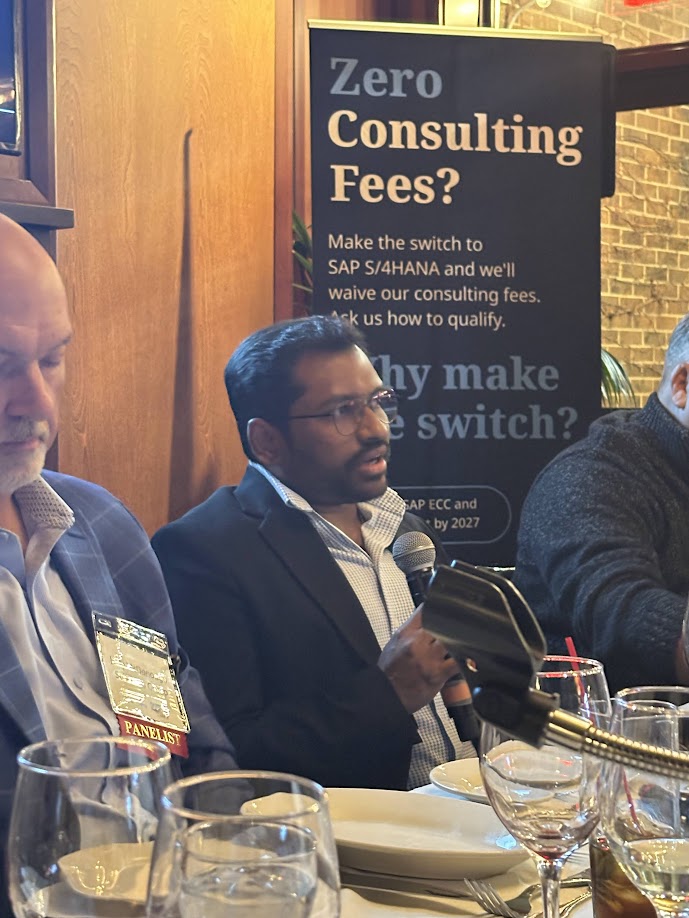
Featured panel
A cross-functional discussion spanning consumer products, manufacturing, data architecture, and enterprise IT.
NTT DATA Business Solutions
Executive Advisor and Principal — Consumer Products and Agribusiness

SAP
Consumer Products Industry Advisor — Midwest Region

Pampered Chef
Senior Data Architect Manager

Sub-Zero Group, Inc.
VP of IT / CIO
Key themes
Five themes framed the discussion about resilience, cost, data readiness, and AI.
Supply chain disruptions are now continuous. Organizations are redesigning processes to absorb shocks and respond dynamically, rather than optimizing solely for steady-state efficiency.
After a period dominated by availability and service, cost optimization is re-emerging as a priority due to inflation, tariffs, and consumer resistance to price increases.
AI effectiveness depends on digitized, accurate, and integrated data. Many organizations are still focused on building reliable data pipelines before scaling advanced analytics or AI agents.
The most successful AI initiatives are narrowly scoped and tied to measurable outcomes—such as freight optimization, packaging efficiency, demand sensing, or service-part prediction.
Enterprises are evolving from rule-based and deterministic planning models toward multi-agent AI systems that collaborate across functions while retaining human oversight.
The operating principle
Advantage comes from getting to Plan B faster.
Scenario planning, data transparency, and orchestrated decision-making are what turn a disruption into an opportunity rather than a scramble.
Actionable takeaways
Seven moves for building supply chains that absorb shocks and still take cost out.
Assume supply chain shocks will continue. Build operating models that prioritize flexibility, scenario planning, and rapid reconfiguration.
Start with finance, procurement, supply planning, logistics, and service workflows where inefficiencies are well understood and ROI can be measured.
Eliminate paper, manual handoffs, and siloed systems. AI delivers value only when underlying processes and data are fully digitized.
Evaluate sourcing, manufacturing, and logistics decisions through both cost and risk lenses to avoid trading short-term savings for long-term fragility.
Deploy AI agents in constrained domains, monitor performance, and introduce human review where error tolerance is low.
Increase real-time data sharing and visibility across supplier networks to detect quality, capacity, and delivery risks earlier.
Prioritize applications that reduce manual effort and compress decision cycles, enabling faster execution when conditions change.
From the room






Event sponsor

NTT DATA is a $30+ billion trusted global innovator of business and technology services. We serve 75% of the Fortune Global 100 and are committed to helping clients innovate, optimize and transform for long-term success. As a Global Top Employer, we have experts in more than 50 countries and a robust partner ecosystem of established and startup companies.
Our services include business and technology consulting, data and artificial intelligence, industry solutions, as well as the development, implementation and management of applications, infrastructure and connectivity. We are also one of the leading providers of digital and AI infrastructure in the world.
Visit nttdata.com ↗