
From Decision to Outcome: Competing at the Speed of Opportunity with AI
A private executive discussion on how supply chain leaders are navigating continuous volatility by improving real-time visibility, accelerating decision-making, strengthening planning fundamentals, and building more resilient, AI-ready operating models.

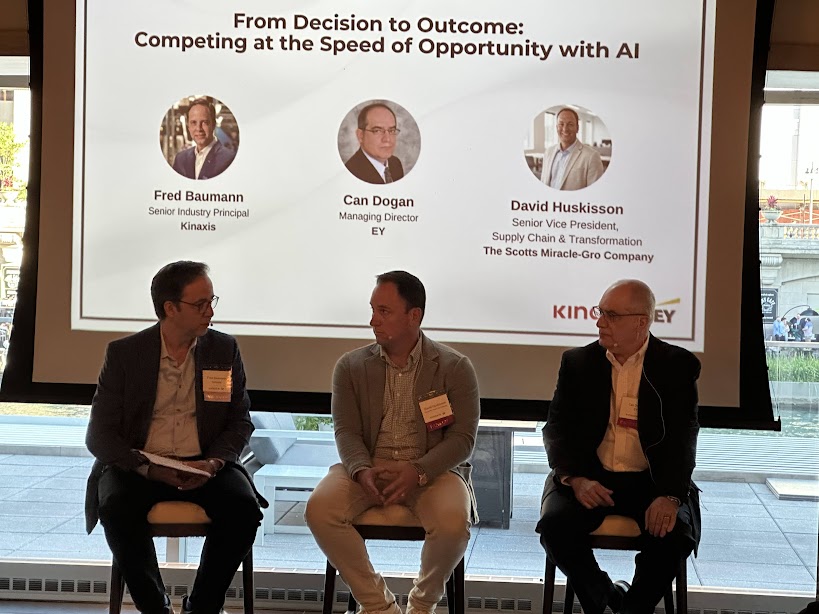
Interactive Dialogue & Discussion Leaders


Senior Vice President, Supply Chain & Transformation ,The Scotts Miracle-Gro Company

What the conversation revealed
Supply chain leaders are operating in an environment where disruption is no longer episodic. Volatility, geopolitical pressure, demand swings, inventory imbalance, and shifting customer expectations have become constant operating conditions. The discussion highlighted that supply chain organizations must move beyond reactive crisis response and build the capability to sense, assess, and respond to change faster and with greater confidence.
A recurring theme was the need to improve decision velocity. In a more volatile environment, slow decisions create lost revenue, excess inventory, service issues, and missed market opportunities. Leaders emphasized that technology, including advanced planning systems and AI, can help organizations detect signals earlier and support faster decisions, but only if the underlying processes, data, and operating model are strong enough to support them.
The conversation also reinforced that supply chain transformation is not only a technology initiative. Organizational design, talent strategy, change management, and knowledge capture are central to building resilient planning capabilities. AI can support forecasting, parameter management, self-healing processes, and decision support, but companies still need strong planning fundamentals, governance, and people who can navigate volatility, uncertainty, complexity, and ambiguity.
What supply chain leaders can apply next
Treat volatility as the baseline, not the exception
Build planning processes that assume disruption will continue rather than relying on periodic crisis response.
Increase real-time visibility across the supply chain
Invest in capabilities that help teams see demand, inventory, capacity, and disruption signals early enough to act.
Prioritize decision speed and decision quality
Measure how quickly teams can assess tradeoffs, align stakeholders, and execute decisions when conditions change.
Strengthen core planning processes before scaling AI
Standardize planning inputs, workflows, decision rights, and escalation paths so technology can amplify strong practices rather than automate weak ones.
Use AI to support planners, not bypass planning discipline
Apply AI to forecasting, parameter detection, exception management, scenario analysis, and knowledge capture while keeping human judgment in the loop.
Build centers of excellence with scalable talent models
Combine senior planning expertise with junior and mid-level talent who can execute consistently through standardized methods and shared tools.
Capture institutional knowledge for future planning models
Document how experienced planners make decisions so AI and automation can be trained on practical business context, not just raw data.
Focus hiring and development on VUCA readiness
Prioritize people who can operate through volatility, uncertainty, complexity, and ambiguity while using technology to guide better decisions.
Create governance for AI-enabled planning
Define how AI recommendations are reviewed, approved, monitored, and improved over time.
Make change management part of the transformation plan
Ensure teams understand how new tools and processes change their roles, decisions, and accountability.
Discussion areas
Disruption Has Become a Permanent Operating Condition
Supply chains are moving from occasional disruption to continuous volatility, requiring leaders to build resilience into daily planning and decision-making.
Decision Velocity Is a Competitive Advantage
Organizations need to make faster, higher-quality decisions as latency increasingly translates into lost revenue, excess cost, or missed customer opportunities.
Technology Must Be Built on Strong Process Foundations
AI and advanced planning tools can improve visibility and automation, but they cannot compensate for weak planning processes or poor organizational alignment.
Organizational Design Matters as Much as Systems
Companies are rethinking talent models, centers of excellence, and the balance between senior expertise and developing planning talent.
AI Requires Governance and Methodology
As AI becomes more embedded in planning, organizations need clear governance models, methodologies, and guardrails to ensure outputs are trusted and scalable.
Knowledge Capture as a Planning Priority
Organizations need to preserve expert decision logic so teams and AI tools can learn from it.
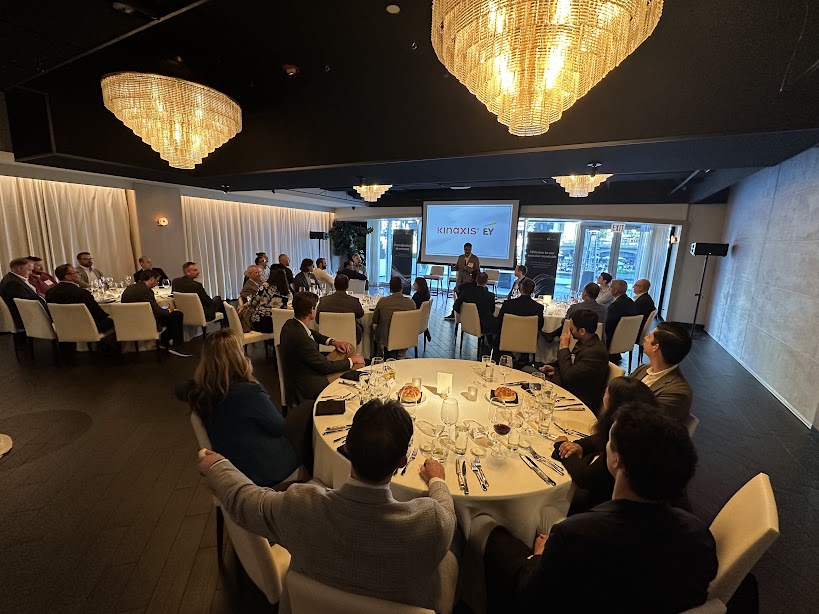
Scenes from the event






About Kinaxis
Kinaxis is a global leader in modern supply chain planning and orchestration, powering complex global supply chains and supporting the people who manage them. Our powerful, AI-infused supply chain orchestration platform, Maestro™, combines proprietary technologies and techniques that provide full transparency and agility across the entire supply chain – from multi-year strategic planning to last-mile delivery. We are trusted by renowned global brands to provide the agility and predictability needed to navigate today’s volatility and disruption. For more news and information, please visit axkinis.com or follow us on LinkedIn.

About EY
EY exists to build a better working world, helping create long-term value for clients, people and society and build trust in the capital markets. Enabled by data and technology, diverse EY teams in over 150 countries provide trust through assurance and help clients grow, transform and operate. Working across assurance, consulting, law, strategy, tax and transactions, EY teams ask better questions to find new answers for the complex issues facing our world today. For more information about our organization, please visit ey.com.