
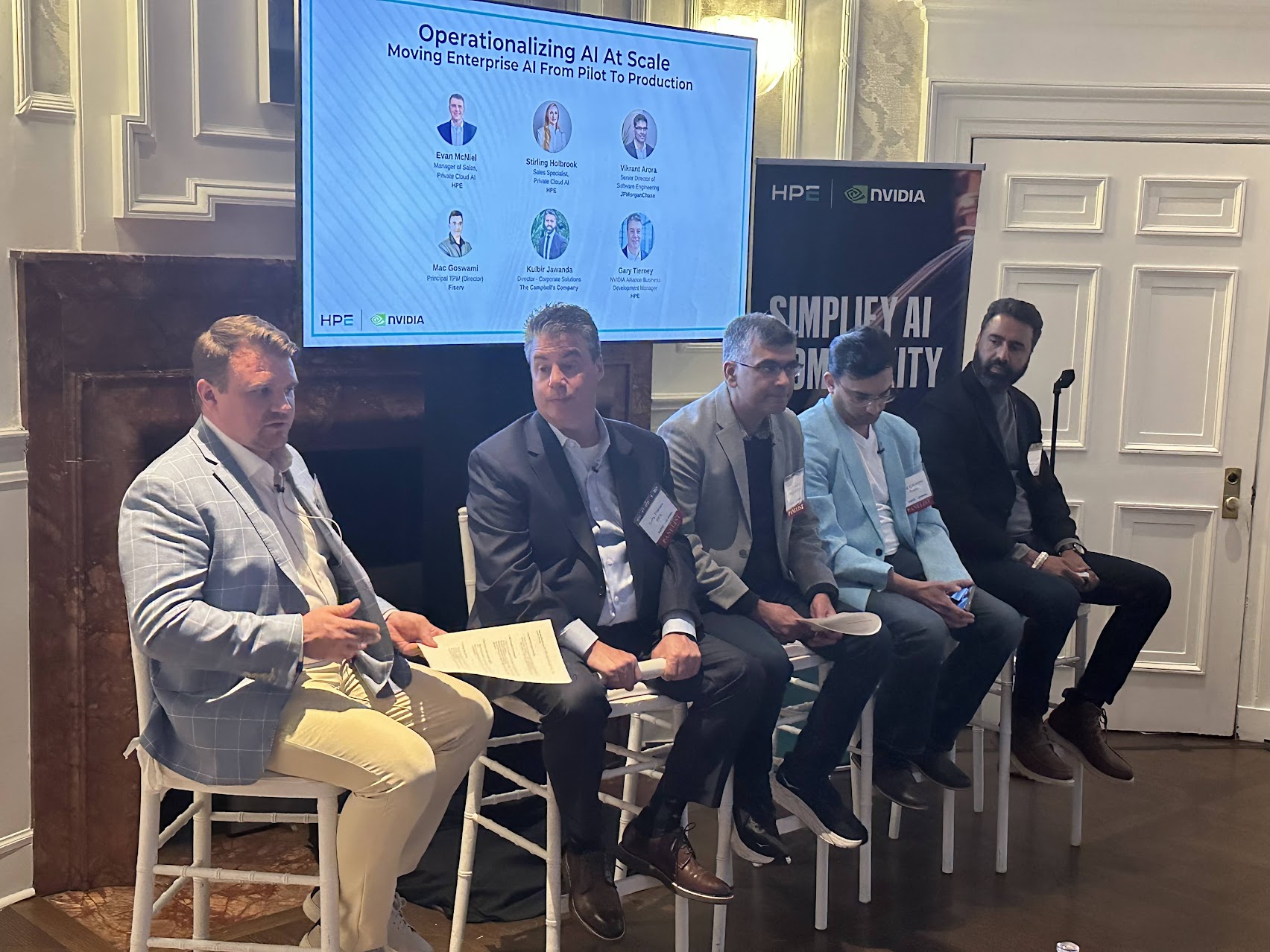
Panel
Evan McNiel
Manager of Sales - Private Cloud AI
HPE


Executive summary
Enterprise leaders across financial services, healthcare, consumer goods, and technology are moving beyond AI experimentation and focusing on how to operationalize AI at scale. The discussion centered on the growing need to align AI initiatives with measurable business outcomes, while also addressing governance, adoption, infrastructure readiness, and organizational change management. Leaders emphasized that many organizations are still early in their AI maturity journey, despite widespread executive pressure to accelerate adoption.A recurring theme throughout the conversation was the gap between AI enthusiasm and operational readiness. Many enterprises are deploying AI pilots without fully understanding the underlying business problem, the data requirements, or the long-term infrastructure and governance implications. Panelists stressed that successful AI deployment requires more than selecting a model or implementing a chatbot. It requires disciplined engineering practices, clear operational metrics, strong platform governance, and a deliberate strategy for building trust with users. Human oversight, explainability, and reliability remain critical, particularly in highly regulated industries where AI-driven decisions directly impact customers, patients, and financial operations.The discussion also highlighted that AI adoption is becoming a broader organizational transformation rather than a standalone technology initiative. Companies are increasingly investing in AI literacy, cross-functional collaboration, and internal enablement programs to help teams understand where AI delivers value and where traditional automation or workflow improvements may be more appropriate. Organizations that succeed will be those that balance experimentation with governance, prioritize practical use cases, and treat AI as a long-term operational capability rather than a short-term innovation trend.
The discussion
Manager of Sales - Private Cloud AI

Director - Enterprise Platforms

NVIDIA Alliance Business Development Manager

Senior Director of Software Engineering, JPMorganChase

Fiserv logo AI Transformation Leader || Principal Technology Program Manager

Sales Specialist — Private Cloud AI
Key themes
Successful initiatives depend on alignment across IT, operations, legal, risk, compliance, and business teams, with governance and readiness gaps often slowing adoption more than technical limitations.
Leaders emphasized tying AI deployments to measurable operational goals such as productivity gains, reduced manual work, faster processing times, and improved customer experiences.
Enterprises continue to prioritize human-in-the-loop models, evaluation frameworks, and explainability to ensure AI systems produce accurate and reliable outcomes.
Many employees still misunderstand the differences between AI, automation, machine learning, and generative AI, driving increased investment in education and practical enablement.
Data quality, security, workload placement, access controls, and governance frameworks are increasingly viewed as foundational to scalable AI adoption.
Actionable takeaways
Focus AI initiatives on measurable operational challenges rather than deploying AI for visibility or experimentation alone.
Early wins in meeting summarization, document retrieval, workflow automation, and knowledge management can build organizational trust and adoption.
Create training programs that explain practical use cases, limitations, prompt engineering basics, governance expectations, and responsible usage guidelines.
Treat adoption, user trust, and behavioral change as core success metrics from the beginning of any deployment.
Use human-in-the-loop approaches in regulated, customer-facing, or high-risk operational environments to improve trust and reduce risk exposure.
Apply platform engineering practices such as telemetry, observability, CI/CD pipelines, monitoring, evaluation frameworks, and automated testing to AI workloads.
Determine whether sensitive workloads should remain within private infrastructure versus public cloud or closed-model providers based on governance, compliance, and data sensitivity.
Standardize data sources, improve data quality, and establish clear ownership models before scaling AI initiatives across the enterprise.
Establish policies around security, ethical AI, access management, validation, and model usage early to reduce operational and compliance risk.
Position AI as a capability that enhances employee productivity, accelerates workflows, and improves decision-making rather than framing it solely as workforce reduction.
Event moments







Presented by

Unlock your boldest ambitions with Hewlett Packard Enterprise, your essential partner for the AI era. HPE uses the power of AI, cloud, and networking to help you move faster, work smarter, and achieve more. With deep expertise and bold ingenuity, we empower organizations to turn data into foresight, elevate performance, and drive real-world impact—at scale. Rooted in decades of innovation, we focus on helping companies adapt, grow, lead, and challenge the limits of what’s possible. www.hpe.com
Learn more about HPE ↗
NVIDIA is a full‑stack, accelerated computing company that delivers the AI infrastructure and software powering the world’s most demanding enterprises, from cloud to data center to factory floor. We combine industry‑leading GPUs, high‑performance networking, and optimized software into integrated platforms that enable you to build, deploy, and scale generative AI, digital twins, and advanced analytics with unmatched performance and efficiency. As the engine behind many of the world’s largest clouds and AI initiatives, NVIDIA helps organizations transform their data into a competitive advantage, modernize their core systems, and accelerate innovation while reducing total cost of ownership and time to value.
Learn more about NVIDIA ↗