
VistaVu Solutions
Devin Timberlake
Senior Vice President Strategy


Post-event recap
Unifying ERP and AI for smarter business — why data maturity, operating discipline, and change management decide whether AI delivers, long before the tools do.
Executive summary
Enterprise leaders are approaching AI with growing realism, recognizing that long-term value depends far more on data maturity, operating discipline, and change management than on tools alone. The discussion consistently framed AI as the last step in a broader transformation journey, not the first. Organizations that rushed into AI without unified data, clear ownership, or defined use cases are seeing stalled pilots, cost overruns, and internal resistance. In contrast, teams that invested early in ERP modernization, data pipelines, and governance are now positioned to extract meaningful insights and automate core workflows.
A recurring insight was that AI success is incremental and operational, not transformational overnight. Most organizations are operating across multiple stages simultaneously—modernized in some areas, fragmented in others. Leaders emphasized that measurable gains are coming from targeted use cases such as invoice processing, financial close activities, procurement optimization, and decision support, rather than broad “AI everywhere” strategies. These wins build credibility, develop internal capability, and create momentum for larger initiatives.
Looking ahead, competitive advantage will come from sequencing and discipline: defining business problems first, preparing clean and trusted data, setting financial guardrails, and actively managing the human impact of automation. AI is increasingly viewed as a productivity layer embedded into core systems, not a standalone capability—one that rewards organizations willing to invest patiently, govern rigorously, and scale deliberately.
Featured speaker
VistaVu Solutions
Senior Vice President Strategy
Key themes
Five themes framed the discussion about data maturity, targeted use cases, and cost control.
Organizations cannot generate reliable AI outcomes without clean, unified, and governed data pipelines across ERP, finance, operations, and customer systems.
Few organizations are fully AI-ready. Most span early-stage fragmentation and more advanced pockets of automation at the same time.
Narrow, high-friction workflows—such as accounts payable, reconciliation, forecasting, and procurement—are producing faster and more defensible ROI.
Token-based pricing models and usage-driven AI platforms are creating budget unpredictability, elevating the importance of financial controls and FinOps discipline.
Resistance from end users—driven by job security concerns and workflow disruption—can stall AI initiatives unless addressed proactively through communication and training.
The operating principle
Advantage comes from sequencing and discipline.
Define the business problem first, prepare clean and trusted data, set financial guardrails, and manage the human impact of automation — in that order.
Actionable takeaways
Seven moves for sequencing ERP and AI work so the wins compound.
Require every AI effort to clearly define the operational pain point, expected efficiency gain, and success metrics before funding.
Prioritize ERP modernization, data integration, and governance to ensure AI outputs are accurate, explainable, and trusted.
Break initiatives into clear phases with go/no-go decision points to control risk, cost, and scope creep.
Establish usage limits, monitoring, and budget thresholds for AI platforms to prevent uncontrolled cost escalation.
Focus on automating repetitive, well-understood processes to demonstrate value and build organizational confidence.
Communicate clearly how AI augments roles rather than replaces them, and equip employees with training before deployment.
Integrate AI into core systems and workflows where users already operate, rather than introducing disconnected platforms.
From the room


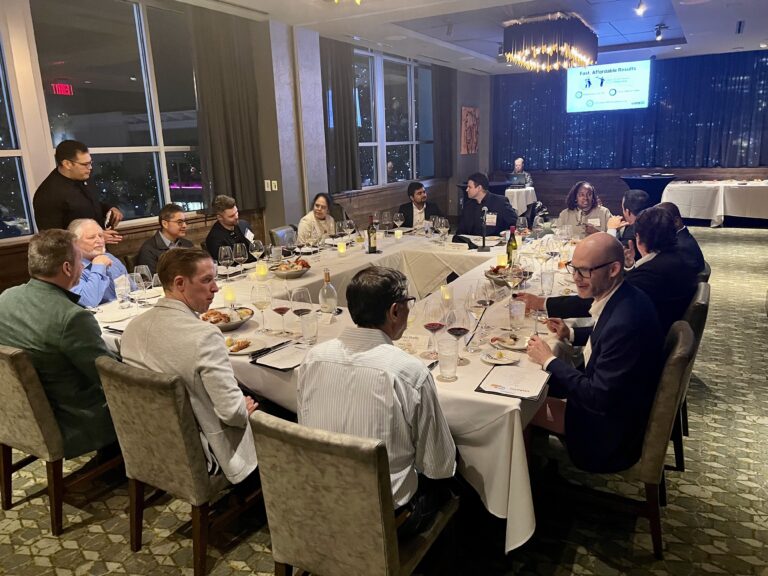





Event sponsor

VistaVu Solutions, one of the top SAP-certified partners in North America, is a focused, rapidly-growing, and progressive provider of innovative business management solutions for several industries including concentrations in Wholesale Distribution, Industrial Field Services, Manufacturing, and others.
VistaVu leverages the experience of its people, and the results of its successfully proven processes to bring industry-driven, user-focused and mature business management solutions to industrial field services companies across North America.
Visit vistavusolutions.com ↗