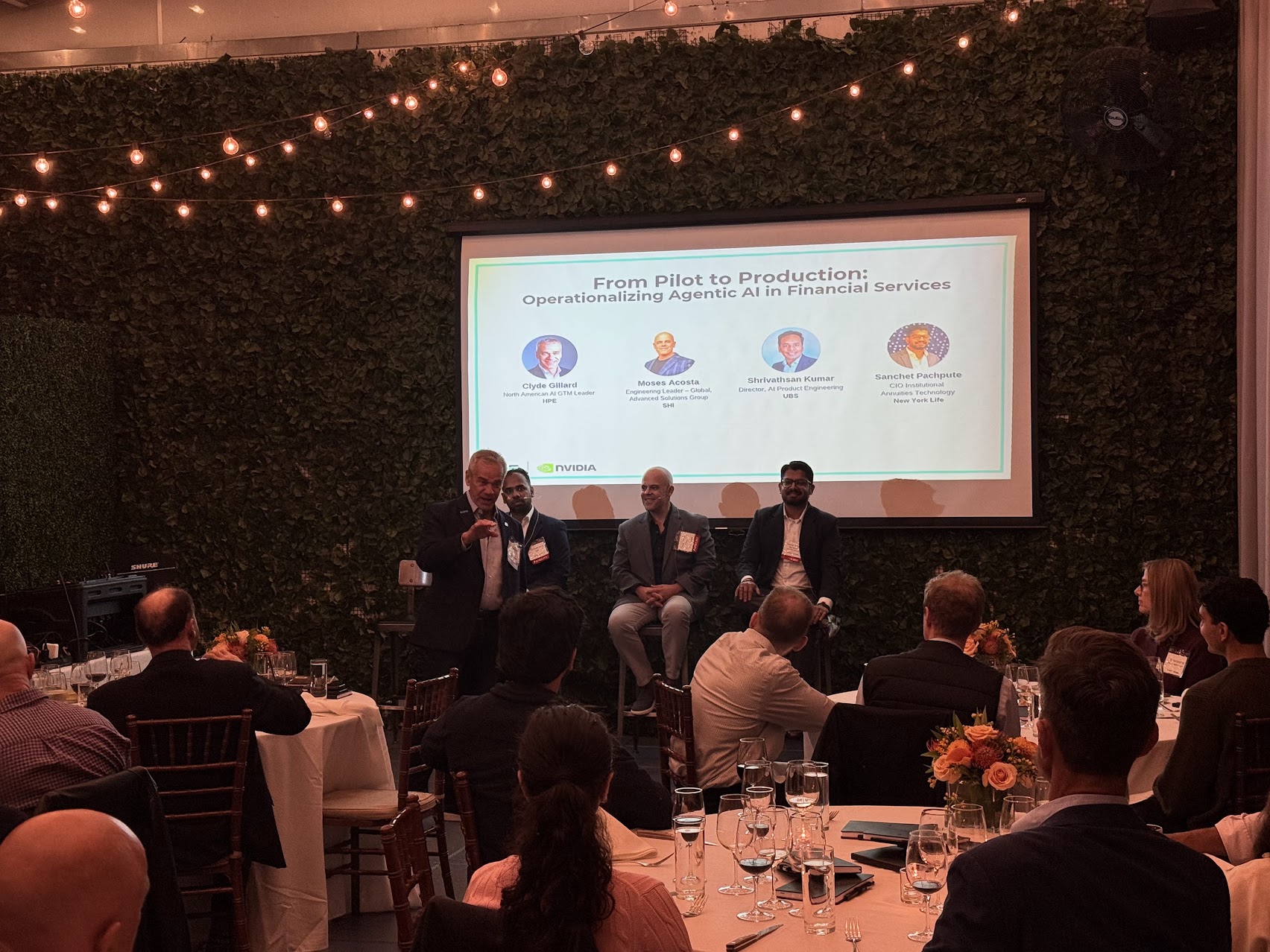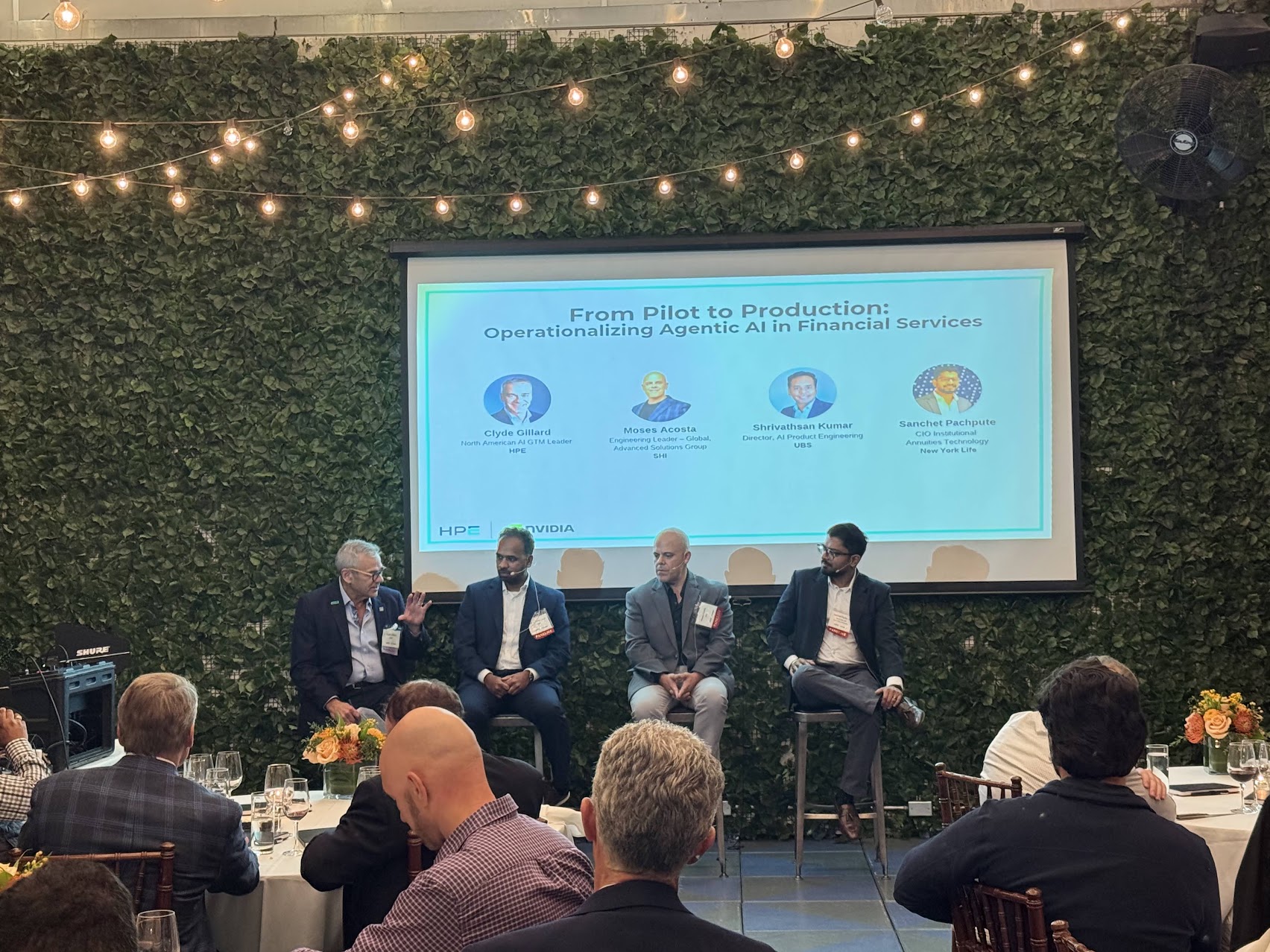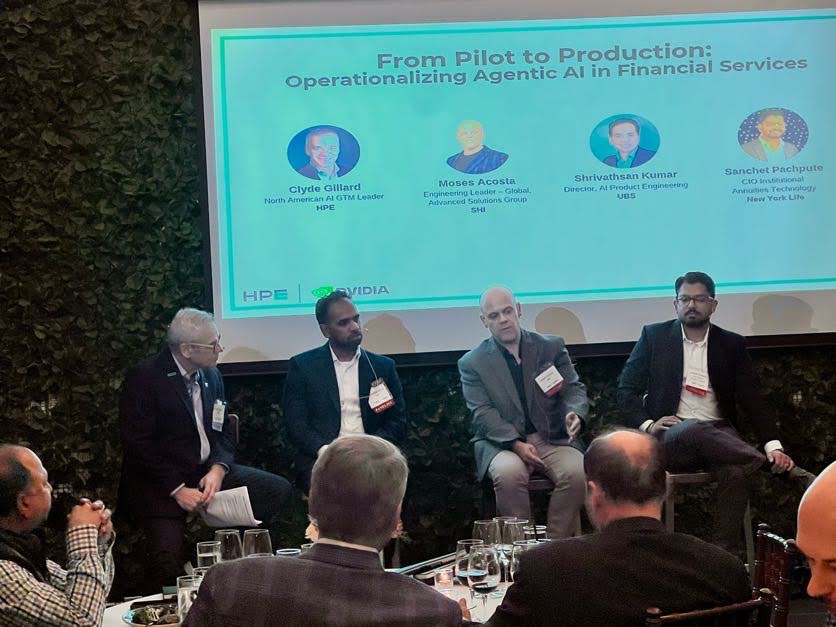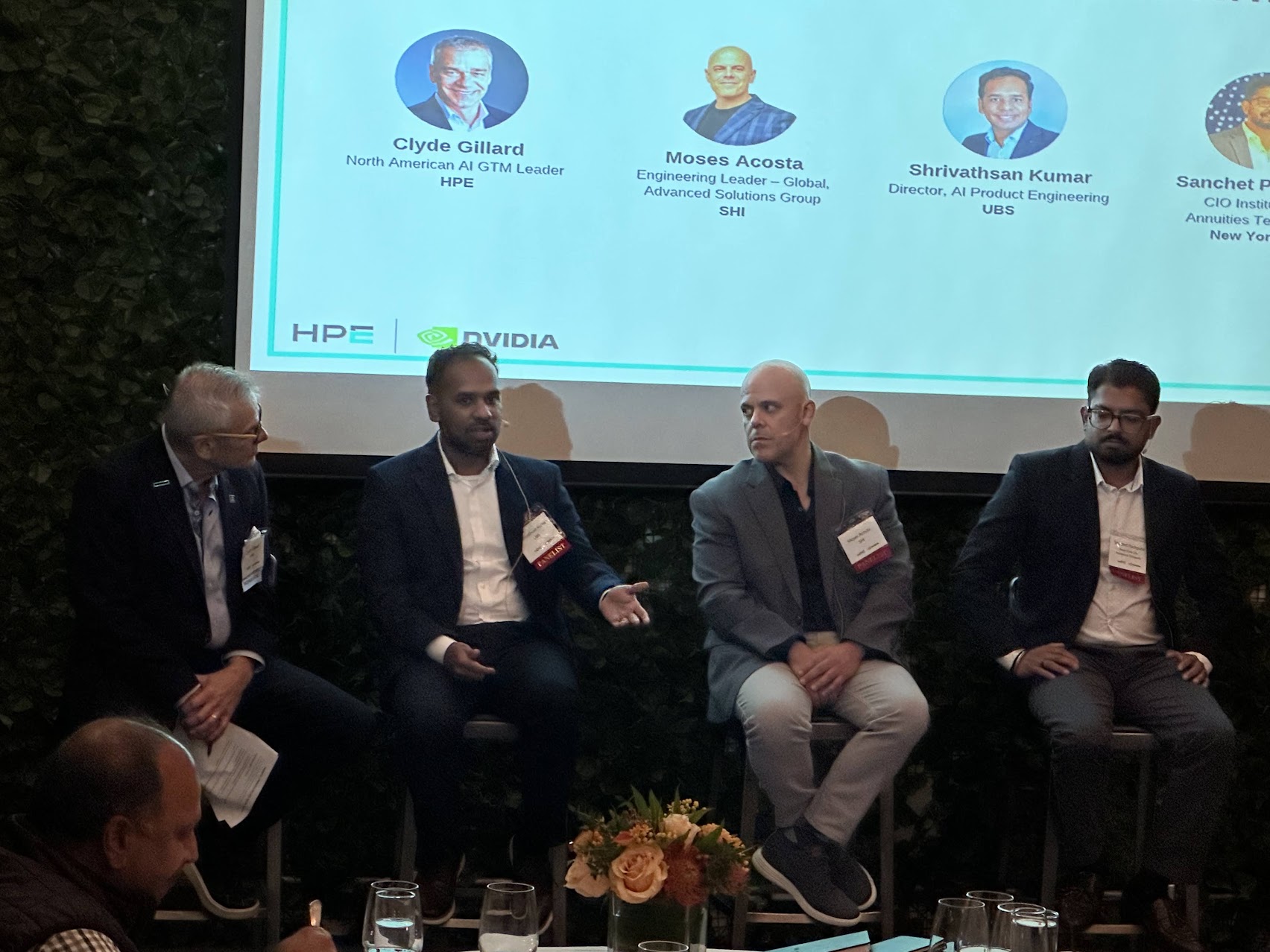

From Pilot to Production: Operationalizing Agentic AI in Financial Services
Private Executive Dinner & Wine Tasting
Executive summary
Scaling AI from isolated wins to enterprise capability
Enterprise AI has moved beyond the question of whether it can create value. The challenge now is how to scale successful use cases across the organization without losing control of cost, data, risk, or customer trust. Financial institutions are increasingly finding that production success depends less on model sophistication and more on the surrounding foundations, including data quality, infrastructure, context, governance, and clearly defined business ownership.
Agentic AI introduces a new operating model in which organizations must decide where autonomy is appropriate and where human oversight remains essential. Low-risk, repeatable workflows can be automated more aggressively, while high-impact activities involving money, customer decisions, or regulated processes require tighter controls. As the number of agents grows, organizations will also need stronger mechanisms for monitoring, accountability, escalation, and agent-to-agent coordination.
The discussion also reinforced that AI should not be deployed simply because the technology is available. The most effective initiatives begin with a high-value business problem, select the right architecture for that problem, and scale only after the economics and operational requirements are understood. Data and infrastructure will increasingly determine which organizations can turn isolated AI successes into durable enterprise capabilities.
Featured discussion
Perspectives from the room



Sanchet Pachpute
CIO Institutional Annuities Technology
Key themes
What the room explored
- 01
Scaling AI Requires Stronger Foundations
Production environments expose data quality, infrastructure, latency, context, and governance issues that are often hidden during pilots.
- 02
Use-Case Selection Matters More Than Technology Novelty
AI creates the most value when applied to meaningful business bottlenecks rather than replacing deterministic processes that already work.
- 03
Autonomy Must Reflect Business Risk
Low-risk workflows can move toward greater automation, while high-impact financial and customer decisions require stronger oversight and controls.
- 04
Data Is Becoming the Core Enterprise AI Asset
Reliable, contextualized, and accessible data is essential for training, grounding, inference, and scaling agentic systems.
- 05
Infrastructure and Economics Shape AI at Scale
Model selection, GPUs, cloud versus on-premises deployment, latency, cooling, capacity, and token consumption all become strategic considerations in production.
Operating principle
Solve the right business problem first, then build the data, architecture, and controls required to scale it safely.
Actionable takeaways
What enterprise leaders can do next
- 01
Start with one or two high-value business problems
Focus AI investment on measurable bottlenecks tied to productivity, growth, customer experience, or operational efficiency.
- 02
Validate with production-quality data early
Test against representative enterprise data before scaling so teams can uncover context, quality, and edge-case issues.
- 03
Segment use cases by risk
Apply greater autonomy to low-risk activities while maintaining human or deterministic controls for sensitive decisions.
- 04
Assign clear ownership to every agent
Define the business owner, escalation path, monitoring responsibilities, and accountability for agent actions.
- 05
Design the architecture for scale from the beginning
Consider expected user volume, latency, model requirements, infrastructure capacity, and data location before production deployment.
- 06
Use the right model for the job
Avoid defaulting to the newest or largest model when smaller, specialized, or deterministic solutions can deliver the required outcome more efficiently.
- 07
Treat data foundations as a strategic investment
Improve data quality, context, feedback loops, and accessibility so AI systems can operate reliably across enterprise workflows.
- 08
Balance rapid experimentation with long-term capability building
Use small teams to test and learn quickly while simultaneously investing in the data, architecture, governance, and infrastructure required for enterprise scale.
The room
Companies represented
Senior leaders from financial services, technology, healthcare, and professional services were represented in the room.
Event photography
From the room
Presented by
Event sponsors

Unlock your boldest ambitions with HPE, your essential partner for the AI era. HPE uses the power of AI, cloud, and networking to help you move faster, work smarter, and achieve more. With deep expertise and bold ingenuity, we empower organizations to turn data into foresight, elevate performance, and drive real-world impact—at scale. Rooted in decades of innovation, we focus on helping companies adapt, grow, lead, and challenge the limits of what’s possible.
Learn more about HPE ›

NVIDIA is a full-stack accelerated computing company delivering the AI infrastructure and software that power demanding enterprise workloads from cloud to data center to factory floor. Its integrated platforms combine industry-leading GPUs, high-performance networking, and optimized software to help organizations build, deploy, and scale generative AI, digital twins, and advanced analytics with greater performance and efficiency. NVIDIA helps enterprises transform data into competitive advantage, modernize core systems, reduce total cost of ownership, and accelerate time to value.
Learn more about NVIDIA ›