
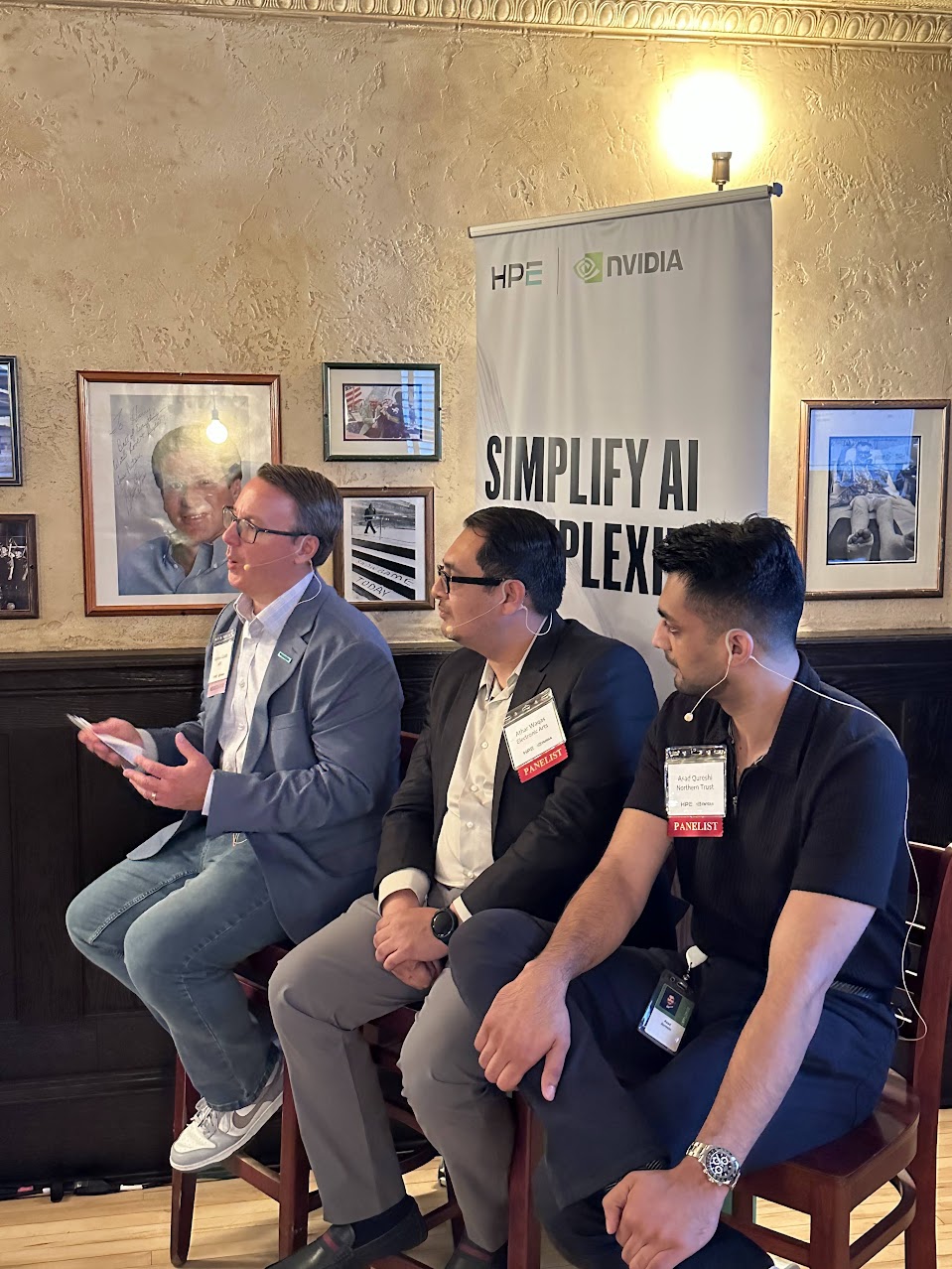
Panel
Andrew Goade
North America Presales Leader Private Cloud AI (PCAI)
HPE


Executive summary
Enterprise leaders are moving AI from experimentation into practical production use, but the conversation made clear that the hardest challenges are not limited to models or infrastructure. The real issues are workload placement, data readiness, governance, cost control, and defining where AI can safely create business value. Organizations are finding that public cloud is effective for testing, prototyping, and rapid experimentation, but production AI workloads often raise new concerns around latency, intellectual property, token economics, regulatory exposure, and long-term operating cost.A major theme was the need to treat AI as an extension of core enterprise architecture, not as a standalone tool. Leaders emphasized that AI should be evaluated through the same disciplines that govern infrastructure, automation, cybersecurity, and business operations. This includes understanding which workloads belong in the cloud, which should remain on-prem, what data should be exposed, how models are monitored, and where human oversight is still required. The discussion reinforced that AI without strong data governance is likely to produce unreliable outputs, unnecessary cost, and operational risk.The conversation also highlighted a cultural and workforce shift. AI is changing how teams work, how business users access information, and how organizations think about automation. However, success depends on AI literacy, disciplined adoption, and clear boundaries around what employees can share with public tools. The strongest organizations will be those that combine experimentation with mature governance, protect sensitive data, and focus AI efforts on measurable business outcomes rather than hype.
The discussion
North America Presales Leader Private Cloud AI (PCAI)

Director Enterprise Architecture

Principal | Compute Platform, Automation, Artificial intelligence and Operations

Private Cloud AI Sales Specialist
Key themes
Enterprises are weighing public cloud, private cloud, and on-prem infrastructure based on cost, latency, IP protection, and production scalability.
Poorly tagged, outdated, or unstructured data limits the effectiveness of RAG, agentic workflows, and internal AI assistants.
Organizations are drawing sharper lines between what can be shared with external tools and what must remain inside controlled environments.
Leaders stressed that not every workflow is ready for agents. Processes should first be evaluated for automation fit, data access, risk, and operational impact.
Employees need clearer guidance on what AI can do, what it cannot do, and what data should never be entered into public or unmanaged tools.
Actionable takeaways
Separate experimentation, internal productivity, customer-facing workflows, and IP-sensitive workloads before deciding where they should run.
Public cloud can accelerate pilots, but production workloads should be evaluated against cost predictability, latency, compliance, and data-control requirements.
Build consistent tagging, ownership, and retention standards so AI systems can retrieve relevant, current, and trusted information.
Establish clear policies prohibiting employees from entering company IP, source code, financial data, customer data, or internal strategy into free public AI platforms.
If a process is not stable enough for RPA or structured automation, it is likely not ready for autonomous AI agents.
Where public models are needed, use approved enterprise versions with contractual protections, auditability, and administrative controls.
Review models, tools, data access, external integrations, and business use cases before allowing broad production deployment.
Use central orchestration, subagents, access control, and kill-switch mechanisms so agents can be isolated or shut down if they behave unexpectedly.
Track whether AI reduces manual effort, accelerates delivery, improves quality, or creates measurable business impact.
Focus enablement on safe prompting, data handling, internal AI tools, and realistic expectations rather than assuming employees understand AI by default.
Event moments











Presented by

Unlock your boldest ambitions with Hewlett Packard Enterprise, your essential partner for the AI era. HPE uses the power of AI, cloud, and networking to help you move faster, work smarter, and achieve more. With deep expertise and bold ingenuity, we empower organizations to turn data into foresight, elevate performance, and drive real-world impact—at scale. Rooted in decades of innovation, we focus on helping companies adapt, grow, lead, and challenge the limits of what’s possible. www.hpe.com
Learn more about HPE ↗
NVIDIA is a full‑stack, accelerated computing company that delivers the AI infrastructure and software powering the world’s most demanding enterprises, from cloud to data center to factory floor. We combine industry‑leading GPUs, high‑performance networking, and optimized software into integrated platforms that enable you to build, deploy, and scale generative AI, digital twins, and advanced analytics with unmatched performance and efficiency. As the engine behind many of the world’s largest clouds and AI initiatives, NVIDIA helps organizations transform their data into a competitive advantage, modernize their core systems, and accelerate innovation while reducing total cost of ownership and time to value.
Learn more about NVIDIA ↗