Moderator

Akeyless
Oded Hareven
Co-Founder & CEO
in

Executive event recap
A private conversation on securing AI agents, machine identities, short-lived credentials, certificate lifecycle risk, and the cryptographic changes security leaders need to prepare for.
Executive summary
Enterprises are advancing from early AI experimentation into controlled deployment, but progress remains uneven across industries. Most organizations are still in exploratory or early production phases, prioritizing internal efficiency gains, low-risk use cases, and selective automation. Heavily regulated sectors are progressing more cautiously, balancing innovation with governance, compliance, and risk management requirements. Across industries, the immediate focus is less on transformation and more on understanding how AI fits within existing operational and security frameworks.
As adoption accelerates, the nature of risk is shifting. Initial concerns centered on securing human interaction with AI systems, but attention is now moving toward securing autonomous actions taken by agents. These systems operate at machine speed, often in non-deterministic ways, introducing challenges that traditional governance, identity, and logging frameworks were not designed to address. Runtime decision-making, dynamic authorization, and continuous validation are becoming essential as enterprises move toward agent-driven workflows.
At the same time, organizations are struggling to quantify value. While efficiency gains are widely reported, few have established reliable baselines or frameworks to measure ROI. This is compounded by the emergence of token-based cost models and the rapid proliferation of AI agents, which can scale faster than governance structures. The result is a growing need for disciplined frameworks that balance experimentation with control, enabling organizations to scale AI responsibly without introducing systemic risk.
Moderator and panel
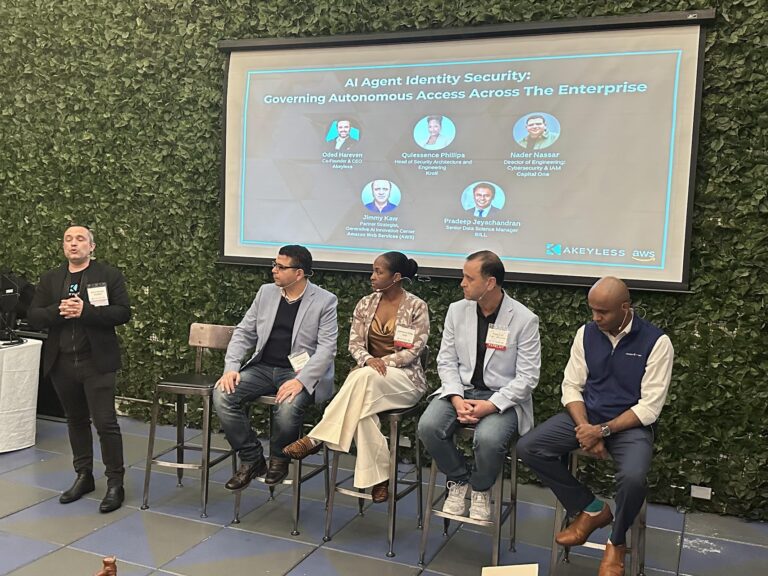
A cross-functional panel spanning identity security, cybersecurity engineering, generative AI, and enterprise data science.
Moderator
Akeyless
Co-Founder & CEO
inSpeaker

Kroll
Head of Security Architecture and Engineering
inSpeaker

Capital One
Director of Engineering: Cybersecurity & IAM
inSpeaker

AWS
Partner Strategist, Generative AI Innovation Center
inSpeaker

Bill
Senior Data Science Manager
inKey themes
The discussion focused on uneven AI maturity, the shift toward autonomous-agent risk, runtime governance, ROI measurement, and the rapid growth of agent ecosystems.
Most enterprises remain in experimental phases, prioritizing internal productivity and low-risk use cases rather than full-scale transformation.
Risk focus is moving toward securing autonomous agent actions and their interactions with enterprise systems.
Traditional design-time controls are insufficient, requiring real-time enforcement of security, authorization, and validation.
Many organizations struggle to quantify value due to missing baselines, inconsistent metrics, and difficulty translating efficiency gains into financial outcomes.
The number of AI agents is scaling quickly, creating challenges in visibility, governance, and user adoption.
Operating principle
Governance has to move from design time to runtime.
As AI systems become more autonomous and non-deterministic, static policies alone are not enough. Enterprises need dynamic authorization, continuous validation, and controls that can evaluate agent actions as they happen.
Actionable takeaways
The discussion translated into a practical set of controls for scaling AI while maintaining governance, measurability, and operational discipline.
Deploy AI in low-risk, internal workflows first while building governance models for broader adoption.
Shift from static, design-time policies to dynamic, session-based authorization and continuous validation of actions.
Structure governance across data, identity, and control layers to simplify risk management and enforcement.
Measure current task duration, cost, and output quality before introducing AI to enable meaningful ROI evaluation.
Move beyond time savings and define how AI contributes to revenue growth, risk reduction, or competitive advantage.
Enable experimentation in isolated environments before promoting validated solutions to production.
Track and categorize agents to prevent duplication, unmanaged growth, and user confusion.
Reduce risk by limiting access duration and scope for both users and AI agents.
Anticipate misuse, unintended actions, and AI-driven security risks, and design controls accordingly.
Embed controls into workflows so security supports innovation rather than slowing adoption.
The room
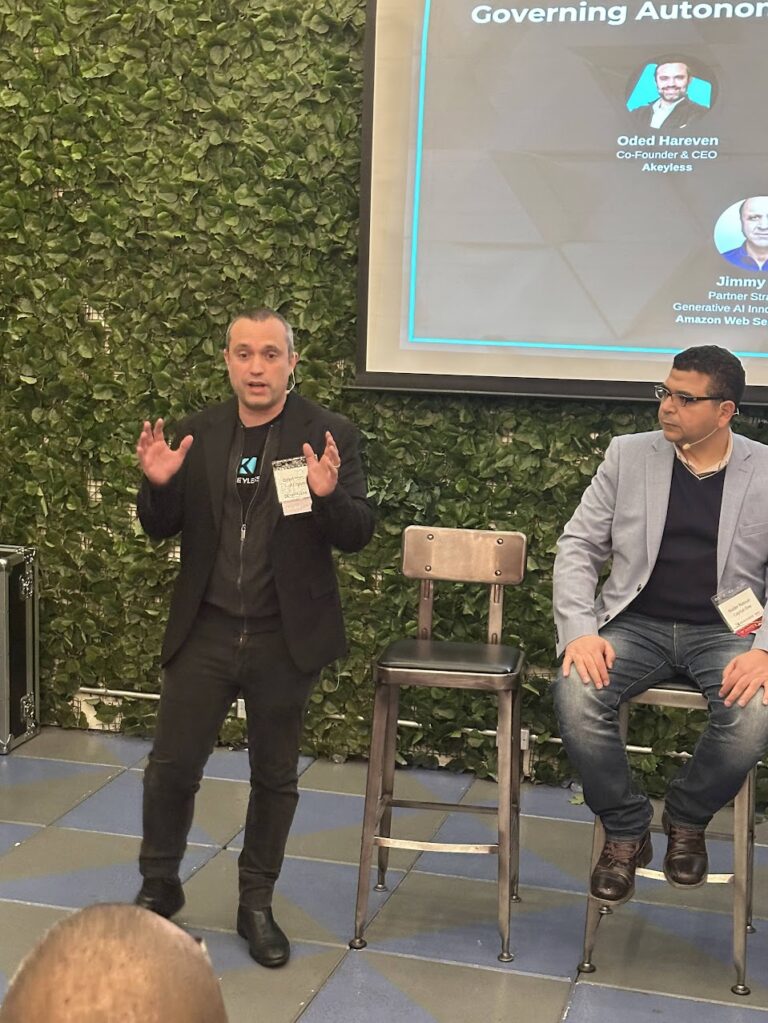
The dinner was designed for senior security and IAM leaders from major enterprises in the New York metro area.
From the room






Event co-sponsors

Akeyless provides a cloud-native Identity Security Platform for securing machine, AI agent, and human identities, with capabilities spanning secrets management, short-lived credentials, certificate lifecycle management, privileged access, and encryption.
Explore Akeyless
Amazon Web Services provides a broad cloud platform spanning compute, storage, databases, networking, analytics, AI, security, and application services used by organizations around the world.
Explore AWS