
Loading Events
Post-event recap

Beyond the Pilot: Operationalizing Agentic AI

Private Executive Dinner & Wine Tasting

Executive summary

What leaders discussed

Enterprise AI is moving quickly from experimentation toward operational use, but the biggest barriers are often organizational rather than technical. Clear ownership, well-understood business processes, and shared accountability between business and technology teams are becoming essential. AI can expose processes that were never fully documented, reveal hidden dependencies on institutional knowledge, and place new demands on infrastructure that was originally designed around human interaction rather than autonomous systems.

As agentic systems gain greater access to enterprise data, applications, and decision-making workflows, governance must become more dynamic. Organizations need to manage agent identity, permissions, context, audit trails, model behavior, and decision provenance while still allowing teams to experiment and innovate. The conversation reinforced that governance should not simply restrict AI. It should provide the structure needed to safely expand its responsibilities over time.

The economics of AI are also becoming more mature. Token costs are only one component of total cost. Data preparation, governance, developer time, infrastructure, retries, evaluation, and operational oversight all contribute to the true cost of an AI-enabled outcome. Enterprise leaders will increasingly need to evaluate AI through business impact, total lifecycle economics, and the level of risk associated with each autonomous decision.

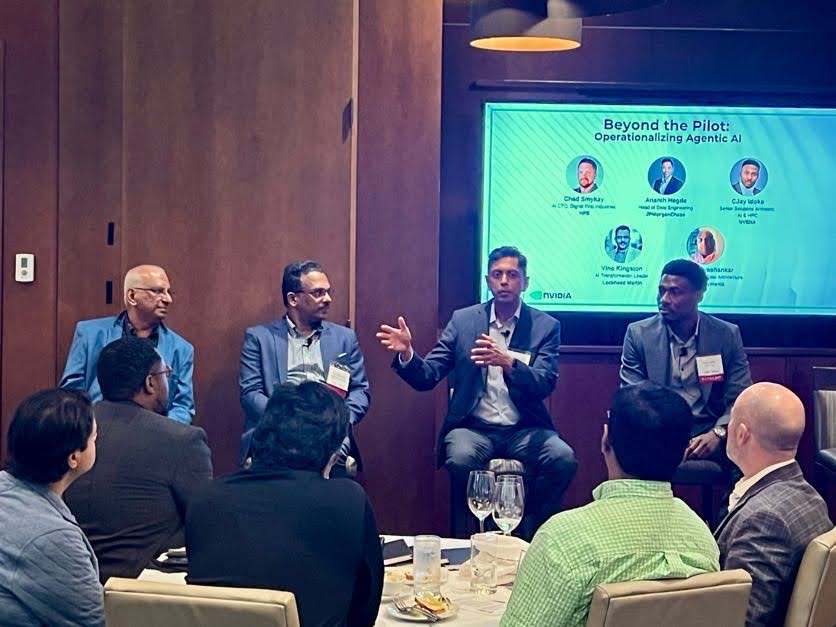
Featured discussion

Perspectives from the room

Chad Smykay
Moderator

Chad Smykay

AI CTO, Digital First Industries

HPE
LinkedIn
Ananth Hegde
Panelist

Ananth Hegde

Head of Data Engineering

JPMorganChase
LinkedIn
CJay Idoko
Panelist

CJay Idoko

Senior Solutions Architect - AI & HPC

NVIDIA
LinkedIn
Vino Kingston
Panelist

Vino Kingston

Data & AI Transformation Strategy and Integration Leader

Lockheed Martin
LinkedIn

Venu Vidyashankar
Panelist

Venu Vidyashankar

Leader - Enterprise Data Architecture

Global Payments
LinkedIn

Key themes

What the room explored

  1. 01

    AI ownership must extend beyond IT

    Business leaders need responsibility for outcomes, budgets, and priorities while technology teams provide the platforms and capabilities needed to execute.

  2. 02

    Process readiness comes before automation

    AI cannot reliably automate workflows that organizations themselves do not fully understand. Hidden manual steps, undocumented knowledge, and unclear decision paths become immediate barriers to scale.

  3. 03

    Governance must evolve for autonomous agents

    Agent identity, permissions, decision context, auditability, and continuous monitoring are becoming foundational enterprise controls.

  4. 04

    Business outcomes matter more than token counts

    Cost management is important, but organizations need to evaluate the full economics of an AI initiative rather than optimizing token consumption in isolation.

  5. 05

    Business context and human judgment remain critical

    Domain knowledge, problem-solving ability, and human judgment become more valuable as AI takes over more routine execution.

Operating principle

Governance should not simply restrict AI.

It should provide the structure needed to safely expand its responsibilities over time.

Actionable takeaways

What enterprise leaders can do next

  1. 01

    Assign clear business ownership to AI initiatives

    Make business teams accountable for the outcomes and value of AI initiatives rather than treating AI as something IT delivers on their behalf.

  2. 02

    Map the real process before introducing agents

    Identify undocumented steps, manual workarounds, human dependencies, and exceptions before attempting to automate the workflow.

  3. 03

    Establish unique identities for autonomous agents

    Do not allow agents to operate through employee credentials. Define identities, entitlements, access controls, and explicit scopes for each agent.

  4. 04

    Match governance intensity to business risk

    A simple information-retrieval agent may require lighter controls than an agent that moves money, modifies systems, or makes regulated decisions.

  5. 05

    Build verification into production operations

    Use monitoring, alerts, thresholds, evaluations, and periodic model comparisons to identify drift or declining performance after deployment.

  6. 06

    Measure the full cost of AI outcomes

    Include model usage, retries, infrastructure, governance, data preparation, engineering time, and operational support when calculating ROI.

  7. 07

    Develop employees who understand both AI and the business

    Prioritize domain expertise, problem-solving, judgment, data literacy, and the ability to apply AI to real business problems rather than narrow tool proficiency alone.

  8. 08

    Treat AI as an enterprise capability, not a specialist function

    Establish central platform capabilities and standards, then embed AI knowledge within business and functional teams so adoption can scale across the organization.

The room

Companies represented

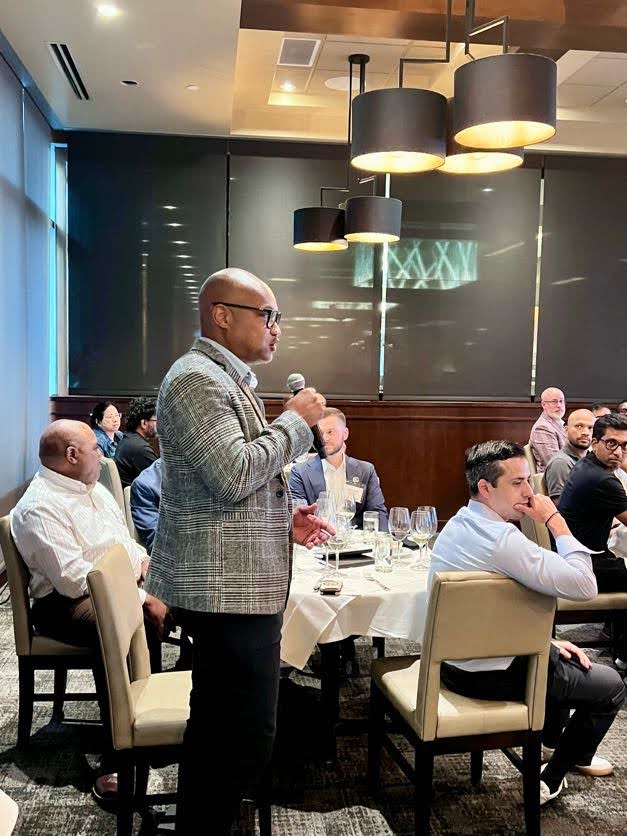
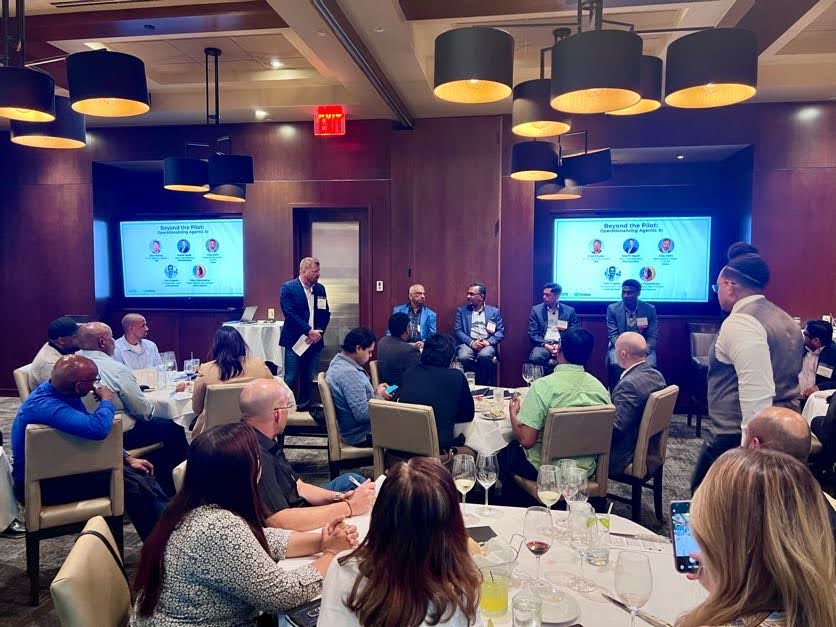
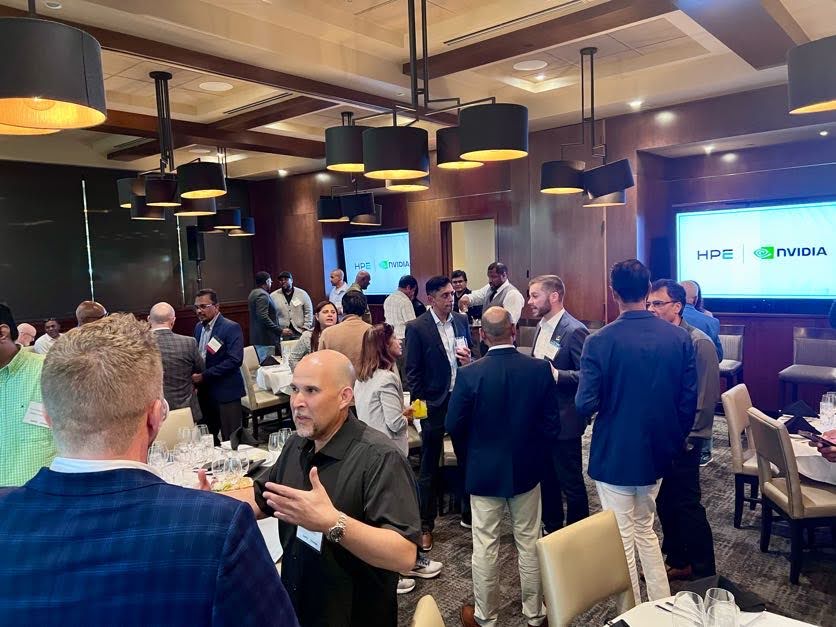
Leaders from the organizations below joined the conversation in Plano, sharing perspectives on business ownership, process readiness, governance, and the economics of enterprise AI.

Riig
The Depository Trust & Clearing Corporation
Texas Instruments
Ericsson
Capital One
Chanel
HCL Technologies
Charter Communications
Verizon Business
Global Payments Inc.
Verizon
Equinix
Deloitte
Provizient
Aetna
Fortinet
JPMorganChase
Thomson Reuters
Nice Systems
Navy Federal Credit Union
University of Texas at Arlington
Databricks
Uniti
Gartner
Kyndryl
American Airlines
St. Jude Medical
NVIDIA
Lockheed Martin
Christus Health
McAfee
HPE
Global Payments
Stripe

Event photography

From the room

Presented by

Event sponsors